In a world where every marketing rupee demands accountability, choosing between performance marketing and traditional advertising isn’t just a budget decision—it’s a growth strategy.
A few years ago, a DTC skincare startup poured its limited funds into billboards across Mumbai. The results? Vanity metrics. Six months later, they reallocated the same budget to influencer-driven performance campaigns on Instagram and saw 3X conversions in 30 days.
This isn’t a hit on traditional—it’s a wake-up call to understand how each model fits within the modern attention economy.
Understanding the Two Advertising Models
What is Performance Marketing in 2025?
Performance marketing refers to advertising where you only pay for measurable results—clicks, leads, app installs, or purchases. While it started with PPC and affiliate marketing, it’s now an umbrella term for:
- Paid Search (Google Ads)
- Paid Social (Meta, TikTok, LinkedIn)
- Influencer-driven campaigns with UTM tracking
- Email retargeting with behavioral segmentation
- Affiliate & referral programs
Thanks to AI attribution tools, marketers now track granular paths across platforms, optimize spend in real time, and measure incremental revenue impact with precision.
What is Traditional Advertising Today?
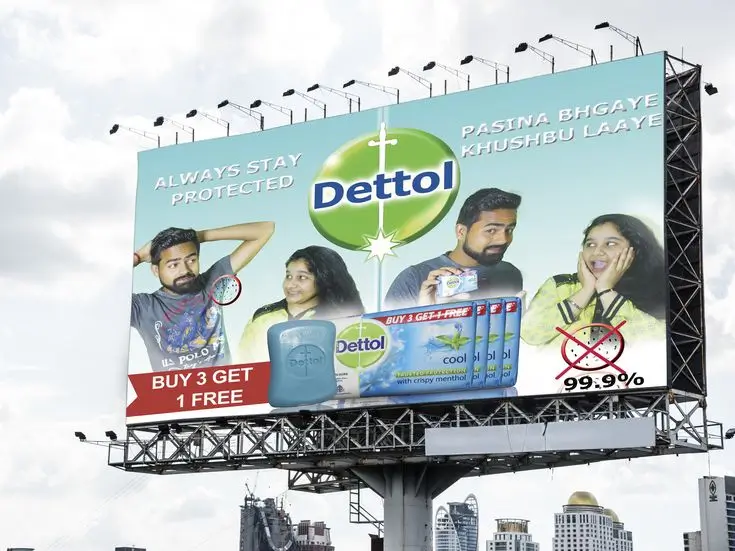
Traditional advertising includes non-digital, mass-reach formats like:
- TV commercials
- Print ads in newspapers/magazines
- Radio spots
- Billboards, transit ads, hoardings
- In-cinema branding
It’s evolved with programmatic media buying, but still thrives on reach rather than clicks. Brand campaigns by companies like LIC, Tata, or Dettol are great examples—they invest heavily in perception and trust, not immediate ROI.
Side-by-Side: 7 Key Differences That Actually Impact Results
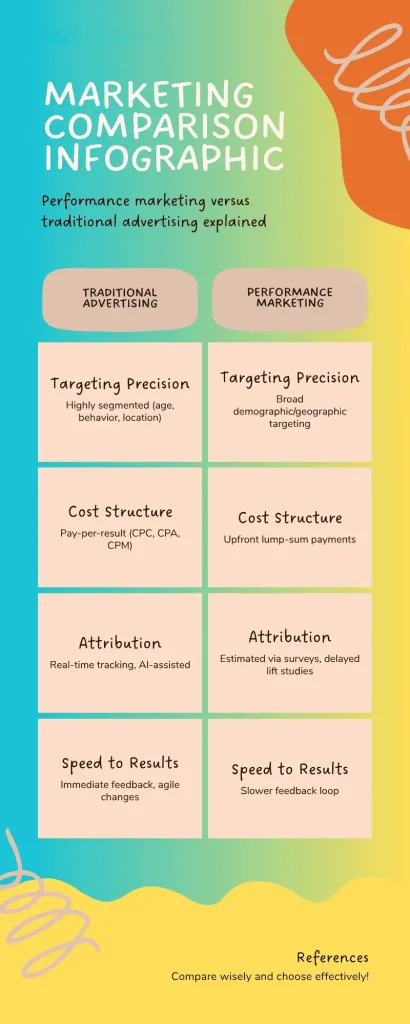
| Criteria | Performance Marketing | Traditional Advertising |
| Targeting Precision | Highly segmented (age, behavior, location) | Broad demographic/geographic targeting |
| Cost Structure | Pay-per-result (CPC, CPA, CPM) | Upfront lump-sum payments |
| Attribution | Real-time tracking, AI-assisted | Estimated via surveys, delayed lift studies |
| Speed to Results | Immediate feedback, agile changes | Slower feedback loop |
| Creative Format | Dynamic, test-and-learn friendly | High-concept, fixed for campaign duration |
| Longevity of Impact | Short bursts, requires refresh | Long-lasting brand recall |
| Budget Flexibility | Adjustable in real-time | Fixed contracts with longer cycles |
When Performance Marketing Works Best
Performance marketing excels in situations where measurability, speed, and direct ROI are critical:
- Early-stage startups testing product-market fit
- DTC brands launching flash sales or product drops
- SaaS companies tracking conversion through free trials
- eCommerce sites scaling ROAS through remarketing
With AI-driven optimization, even small brands can A/B test ads, shift budgets dynamically, and personalize at scale.
When Traditional Advertising Still Wins
Don’t discount traditional just because it lacks dashboards. It still dominates when:
- Mass trust is key (banking, insurance, public services)
- Long-term brand building is the goal
- Nationwide reach is required in a short window
- You’re in high-emotion categories (healthcare, elections, luxury goods)
In 2024, a political campaign in Delhi used a mix of OOH and TV to prime voters, followed by digital retargeting—a strategy that produced a measurable sentiment lift before polling.
The Smart Move: Hybrid Campaigns That Outperform
Modern brands are no longer choosing one over the other—they’re blending both.
Example:
A consumer electronics brand in Bangalore combined a TV campaign for awareness with a search retargeting strategy, leading to a 2.1x improvement in click-to-conversion.
This hybrid approach lets marketers:
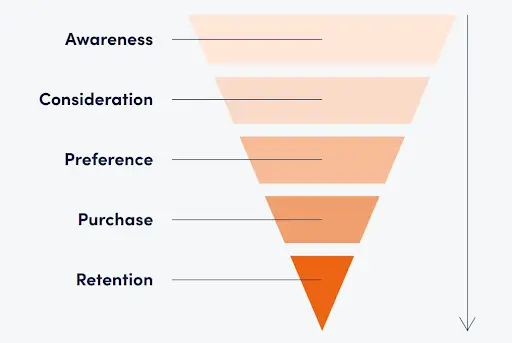
- Generate top-of-funnel awareness through TV, print, or OOH
- Drive mid- and bottom-funnel conversions using performance ads
- Maintain mental availability while optimizing ROAS
Budgeting by Business Model: A Decision Framework
| Business Type | Recommended Channel Mix |
| SaaS | Performance + Podcast/LinkedIn Ads |
| DTC | Retargeting + Print/Influencer Collabs |
| Local Business | Google Ads + Flyers/Radio |
| B2B | ABM Campaigns + Industry Print |
Tool Tip: Create your own blend using a ROI Calculator or Media Mix Planner.
Search for a visual:
- “media mix model by business type India infographic”
- Ideal for turning this section into a downloadable visual asset.
Beyond CPM vs CPC: How Ad Pricing Has Evolved
Today, ad pricing isn’t just impressions vs clicks. You’ll find:
- Performance-based TV placements via programmatic deals
- UGC and influencer campaigns tied to conversion milestones
- CTV ads (connected TV) with pixel-level attribution
This blurs the line between the two models—and rewards smart allocation.
Invisible Metrics That Matter
Your CAC (Customer Acquisition Cost) might lie if:
- You ignore long-term retention
- You don’t count the halo effect of traditional ads
- Offline brand impact isn’t stitched into CRM data
In one campaign, a D2C furniture brand paused ads thinking they weren’t working. A month later, returning customer revenue spiked. The cause? Their prior radio + influencer blitz finally took effect.
Test Budget Blueprint: Know What Works Before Scaling
Use the 70/20/10 rule:
- 70% on proven channels
- 20% on test formats (e.g., CTV or affiliate)
- 10% on experimental moonshots
Always measure across time, channels, and attribution windows. Invest where incrementality—not vanity—shows up.
FAQs You’re Probably Searching Right Now
Q1. Is performance marketing cheaper?
Yes, in the short run—but without brand investment, you risk CPA burnout.
Q2. Can I track ROI in offline ads?
With CTV, QR codes, vanity URLs, and CRM matchback—yes.
Q3. Why do startups favor performance first?
Because they need feedback loops and scale before brand equity.
Q4. Is brand building still worth it?
Absolutely—no brand sustains on sales alone.
Q5. What’s the best blend in 2025?
Performance for velocity, traditional for recall. Together for impact.
Final Verdict: Stop Choosing “Vs”—Start Planning “And”
The smartest marketers aren’t arguing. They’re orchestrating.
Success in 2025 comes from understanding when and how each model contributes.
Use performance to validate and scale, and traditional to build trust and memory. Both have roles. The question is: Are you sequencing them smartly?